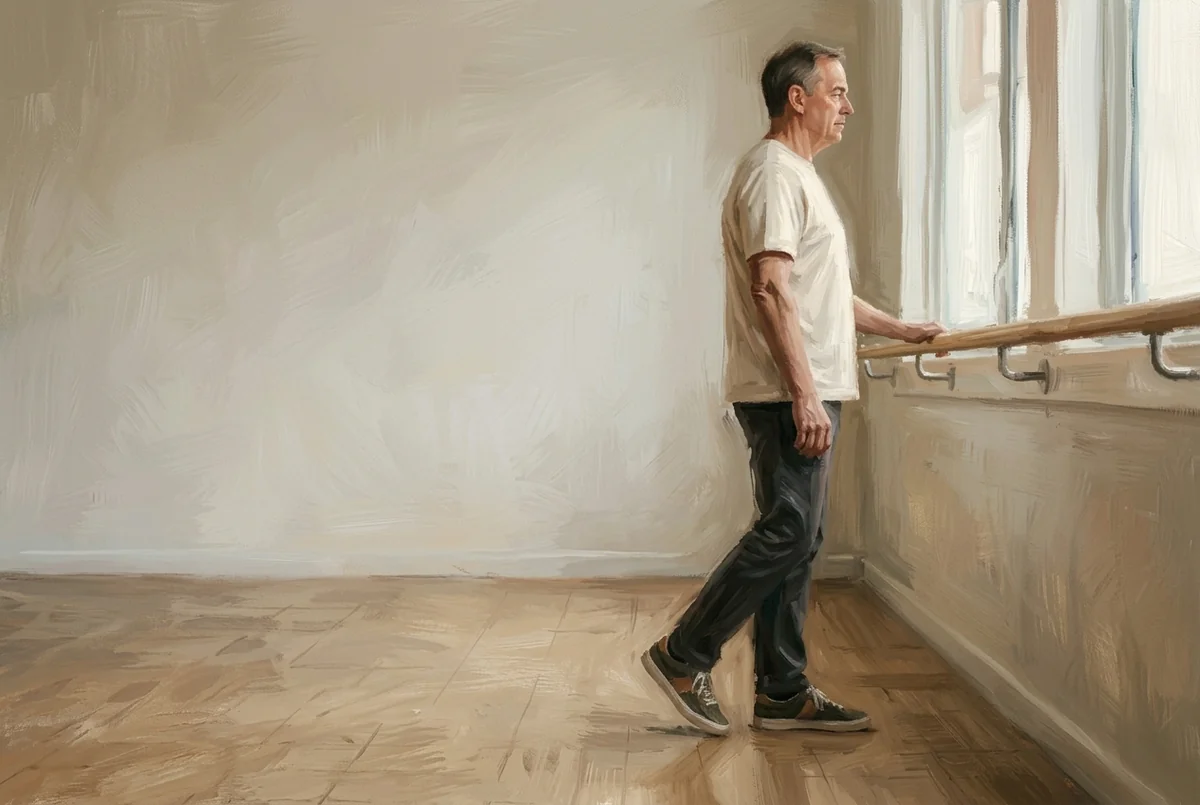
Sometimes the hesitation arrives before the movement. You remember the last painful bend, the step that caught you by surprise, or the exercise that left you sore for days. Now you pause before trying it again.
That concern deserves a place in the conversation. It helps me understand what you are facing.
We look at the concern together
Pain is real. It is also a personal experience influenced by several factors, including physical health, past experiences, and the situation you are in. Understanding those influences can help us ask better questions without dismissing an injury or medical condition.
At Movement Solutions in Wilmette, we start by finding out what makes a particular movement difficult. Is there pain? Weakness? Unsteadiness? Uncertainty about what is okay to attempt? Each answer may lead us toward a different next step.
You do not have to prove how much you can tolerate in the first visit.
Confidence has a practical side
After assessment, we may practice a supported version of a task, reduce the distance or resistance, or break the movement into smaller parts. We agree on what to watch for and how to respond if symptoms change.
Repeating an appropriate task gives us information about your capacity. We also ask how it felt afterward. An easier moment during a session is useful, and the response later that day matters too.
There is room for questions, a slower pace, or a change of plan. You can be interested in getting stronger and still feel uncertain about beginning.
If there is a movement you have been avoiding, you can start by describing it. We can work out an appropriate way forward together.
How the conversation connects to care
Siegel’s introduction to interpersonal neurobiology connects thinking, feeling, and bodily sensations. Here, I listen to your concern while assessing the movement itself.
Vlaeyen and Linton’s review examines pain-related fear and avoidance. It does not establish that a particular movement is safe for you; we assess that question individually.
Ask about the movement you are unsure of.
Sources and further reading
- Siegel, D. J. An Introduction to Interpersonal Neurobiology. Author introduction: integration and autonomy.
- Vlaeyen, J. W. S., & Linton, S. J. (2000). Fear-avoidance and its consequences in chronic musculoskeletal pain: a state of the art. Pain, 85(3), 317–332. Pain-related fear and avoidance.
The practice examples above describe how I approach care. These sources provide background, not a diagnosis or a promise of results.